
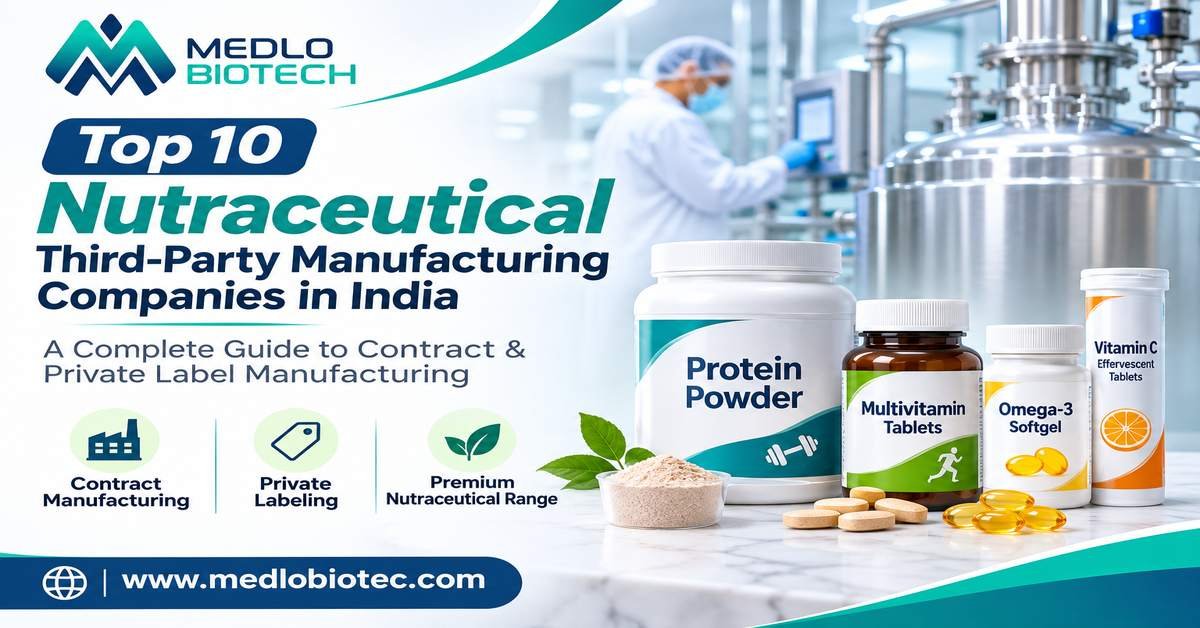
A nutraceutical third-party manufacturing company produces vitamins, protein powders, syrups, capsules and other supplements under your brand name, so you can launch a nutrition range without building a factory. The right partner depends on the dosage forms you need, the manufacturer’s FSSAI licence, quality testing, minimum order quantity (MOQ) and commercial terms.
This guide shortlists the top 10 nutraceutical third-party manufacturing companies in India worth evaluating, then explains what nutraceuticals are, how third-party, contract and private label models differ, which products are commonly made, what the investment involves and which FSSAI rules apply.
It is written for pharma marketers, healthcare distributors, PCD companies and wellness startups planning their own supplement brand.
Top 10 Nutraceutical Third-Party Manufacturing Companies in India Updated List (2027-28)
India has manufacturers that specialise in nutritional product development, third-party and contract manufacturing, private label production and specialised nutrition.
The ten companies below are an informational shortlist based on the services they publish. The order is editorial, not an independent ranking by revenue, capacity, quality or market share. Verify each company’s current licences and capabilities before you shortlist it.
1. Medlo Biotech – No. 1 Nutraceutical Manufacturing Company in India:
Medlo Biotech is a nutraceutical and Ayurvedic third-party manufacturing company with its unit in Barwala Industrial Estate, Panchkula district, Haryana. It offers third-party manufacturing, contract manufacturing, private label manufacturing, formulation assistance and packaging support for pharma marketers, distributors and healthcare brands. Its published range includes nutritional and multivitamin syrups, iron syrups, tablets, capsules, protein powders, sachets, drops and Ayurvedic formulations. Businesses can ask Medlo Biotech for its product list, specifications, packaging options, MOQ and quality documents.
2. Zeon Lifesciences:
Zeon Lifesciences is an Indian nutraceutical contract development and manufacturing organisation (CDMO) offering nutritional product research, formulation development and commercial manufacturing. Its work covers ingredient evaluation, formulation, quality assessment and packaging. It is relevant to brands in nutritional supplements, sports nutrition and specialised wellness. Check its current capabilities, product documentation, MOQ and terms before selecting it.
3. Akums Drugs & Pharmaceuticals Ltd.:
Akums Drugs & Pharmaceuticals is a large Indian CDMO in the pharmaceutical and healthcare sector, with operations that extend into nutraceutical production. It suits businesses looking for established production infrastructure. Identify the specific facility that will make your product and verify its licences, quality systems, dosage-form capability, packaging and commercial requirements.
4. Tirupati Group:
Tirupati Group works in pharmaceutical and nutraceutical manufacturing through its associated businesses, offering outsourced manufacturing across several healthcare product categories. Evaluate it on product availability, infrastructure, technical expertise and quality documents. Confirm which group company and facility will handle your project before signing.
5. Biovencer Healthcare:
Biovencer Healthcare focuses on specialised nutrition, with published product areas including probiotics, enzymes and advanced nutritional formulations. It is relevant for formulations that need extra technical development. Assess formulation capability, ingredient specifications, stability requirements, regulatory classification and documentation.
6. Hexagon Nutrition:
Hexagon Nutrition works in micronutrient premixes, specialised nutrition and nutritional ingredient solutions. Premix manufacturing needs precise ingredient selection and blending consistency. It may suit businesses in food fortification, institutional nutrition and specialised formulations. Entrepreneurs looking for finished retail supplements should confirm that finished-product manufacturing is available for their project.
7. Lactonova Nutripharm
Lactonova Nutripharm works in nutraceutical formulation and manufacturing, with published categories that include sports nutrition, women’s nutrition, digestive wellness and gummies. It offers product development and private label services. Review technical feasibility, facilities, ingredient specifications, packaging, MOQ and quality documents; custom formulas may need stability and regulatory review.
8. Greenwell Lifesciences:
Greenwell Lifesciences advertises nutraceutical third-party manufacturing for healthcare businesses and supplement brands, across tablets, capsules, syrups and powders. It can suit entrepreneurs building a private label portfolio. Compare product specifications, packaging formats, MOQ, pricing, testing and regulatory documents, and confirm the current facility before ordering.
9. Zeon Biotech:
Zeon Biotech works in pharmaceutical and nutraceutical manufacturing and advertises third-party and private label services. Evaluate its formulations, dosage-form capability, infrastructure, packaging services and terms. Zeon Biotech and Zeon Lifesciences are separate businesses and should be assessed independently.
10. Crius Life Sciences:
Crius Life Sciences works in nutraceutical manufacturing, contract production and private label services. Confirm its current facilities, product specifications, packaging services, minimum production quantity and regulatory documents. A written agreement and a clear quotation help define quality, pricing, responsibilities and delivery.
Comparison of Top 10 Nutraceutical Manufacturing Companies in India
| Company Name | Main Manufacturing Focus |
|---|---|
| Medlo Biotech | Nutraceutical and Ayurvedic third-party, contract and private label manufacturing |
| Zeon Lifesciences | Nutraceutical formulation development and contract manufacturing |
| Akums Drugs & Pharmaceuticals | Pharmaceutical and nutraceutical contract production |
| Tirupati Group | Pharmaceutical and nutraceutical manufacturing |
| Biovencer Healthcare | Advanced nutraceuticals and specialised nutrition |
| Hexagon Nutrition | Micronutrient premixes and nutrition solutions |
| Lactonova Nutripharm | Customised nutritional formulations and manufacturing |
| Greenwell Lifesciences | Nutraceutical third-party manufacturing |
| Zeon Biotech | Pharmaceutical and nutraceutical manufacturing |
| Crius Life Sciences | Nutraceutical contract and private label manufacturing |
Each manufacturer specialises in different products and services. Choose a partner based on your actual product requirements, not its position in a list.
What Exactly Is a Nutraceutical?
A nutraceutical is a food-based product made from extracts, isolates or purified compounds that offers a physiological benefit and helps maintain normal health. In India, FSSAI regulates nutraceuticals as a category of food, not as medicines.
In practice, the term covers products containing vitamins, minerals, amino acids, plant extracts, probiotics or other permitted ingredients in specified quantities, sold as tablets, capsules, powders, syrups, sachets or gummies.
Nutraceuticals, health supplements, functional foods and conventional foods are not always the same regulatory category. Under FSSAI’s rules, a health supplement is mainly a concentrated source of nutrients that supplements the diet, while a nutraceutical contains extracts or compounds with a physiological benefit. Classification depends on composition, intended use, labelling and claims.
Nutraceuticals are not automatically medicines. A product that claims to prevent, cure or treat a disease falls outside the nutraceutical rules and needs drug-level authorisation.
What Is the Difference Between Nutraceuticals and Pharmaceuticals?
| Point | Nutraceuticals / Health Supplements | Pharmaceutical Medicines |
|---|---|---|
| Purpose | Nutritional or physiological support, maintaining normal health | Prevention or treatment of specified diseases |
| Regulator in India | FSSAI (Food Safety and Standards Act, 2006) | CDSCO and state drug controllers (Drugs and Cosmetics Act, 1940) |
| Licence | FSSAI licence | Drug manufacturing licence |
| Claims allowed | Permitted nutrition and health claims only | Approved therapeutic indications |
Some ingredients appear in both categories, but regulatory status depends on the full formulation, dose, intended use and claims. A nutraceutical should never replace prescribed medical treatment.
Benefits and Importance of Nutraceutical Products
Nutraceuticals can play a role in nutritional supplementation when chosen for a real need and used as directed. Their benefit depends on the ingredients, dose, product quality, individual needs and the scientific evidence behind them.
1. Helping Address Specific Nutritional Requirements:
Some people need extra nutrients because of dietary limits or life stage. Properly formulated vitamin and mineral supplements can help when dietary intake is not enough. Supplementation should follow actual need, not an assumption that everyone needs more nutrients.
2. Supporting Normal Physiological Functions:
Certain nutrients have established roles in the body. Calcium and vitamin D contribute to normal bone health, and several B vitamins take part in normal energy metabolism. A product’s benefit still depends on its composition and the evidence for its intended use.
3. Offering Convenient Supplementation Formats:
Tablets, capsules, powders, liquids, sachets and gummies let consumers choose a format that suits them. For manufacturers and brands, different formats open product options for specific customer groups.
4. Supporting Particular Dietary Needs:
Different groups can have different requirements, such as extra iron, protein or calcium after a proper nutritional assessment. Products designed for special dietary needs must meet the standards for their category.
5. Encouraging Greater Awareness of Nutrition:
Interest in nutraceuticals encourages people to think about balanced diets, nutrient intake and label reading. Supplements should complement, not replace, a varied diet.
6. Creating Opportunities for Nutritional Product Development:
For businesses, nutraceuticals open categories such as vitamins, minerals, protein nutrition and specialised supplementation. Each opportunity should be tested against market research, compliance, manufacturing quality and realistic demand.
Why Nutraceutical Products Are Important in the Healthcare and Wellness Industry
Nutraceuticals hold a distinct place between food and medicine. They deliver specified nutrients in convenient formats, within FSSAI’s safety and labelling rules.
For healthcare businesses and PCD marketers, they extend an existing portfolio. For manufacturers, the sector involves formulation science, ingredient sourcing, testing and packaging. For entrepreneurs, third-party manufacturing makes it possible to build a supplement brand without a factory.
A responsible nutraceutical business avoids exaggerated claims and prioritises evidence-based product information, accurate labelling, correct regulatory classification and transparent communication.
What Is Nutraceutical Third-Party Manufacturing in India?
Nutraceutical third-party manufacturing is a business model in which a brand owner appoints an external, licensed manufacturer to produce nutritional products to agreed specifications. The manufacturer handles production; the brand owner handles positioning, branding, marketing and distribution.
For example, an entrepreneur planning a multivitamin syrup can contact a third-party manufacturer, choose from available formulations, select packaging and request a quotation. Once specifications and terms are final, production begins.
This lets businesses enter the nutrition market without their own factory. Both the manufacturer and the brand owner must still meet their own regulatory and contractual obligations.
Benefits of Nutraceutical Third-Party Manufacturing
Reduced Manufacturing Infrastructure Investment:
A nutraceutical plant needs machinery, premises, a quality-control laboratory, trained staff, utilities and licences. Third-party manufacturing replaces that capital cost with a per-batch production cost.
Access to Technical Experience:
Tablets, capsules, powders and syrups each need different equipment and process knowledge. An experienced manufacturer brings the facilities and know-how for the dosage forms it supports.
Branding and Product Development Opportunities:
You build your own brand identity while using external production. Many manufacturers also help with formulation and packaging.
Opportunity for Product Range Expansion:
Start with a few products and add more once demand is proven. A manufacturer that handles several dosage forms makes coordination simpler.
Defined Commercial Arrangements:
A written manufacturing agreement sets clear terms for quality, packaging, quantities, pricing, testing and delivery.
Nutraceutical Contract Manufacturing in India
Nutraceutical contract manufacturing means a manufacturer produces your product exactly to a formulation and specification you define. It suits companies that already have a proven formula or want a specific composition developed.
Product Formulation and Development:
The process starts with the product category, ingredients, dosage form and the FSSAI category it will fall under. The manufacturer either works with your existing formula or reviews a custom requirement.
Raw Material Selection:
Ingredients should come from qualified suppliers, with a certificate of analysis and checks against agreed specifications. Every ingredient must be permitted under FSSAI’s schedules or separately approved.
Manufacturing Process:
Each dosage form uses its own equipment and process: blending and compression for tablets, filling for capsules and sachets, mixing and filling for syrups.
Quality Control:
Finished products are tested against the agreed specifications before release, with batch records kept for traceability.
Packaging and Delivery:
Approved batches are packed, labelled and dispatched as per the agreed terms.
Nutraceutical Private Label Manufacturing in India
Nutraceutical private label manufacturing lets you sell supplements under your own brand while the manufacturer produces them, usually from its ready, tested formulations. It is the fastest route for startups, PCD marketers, distributors and wellness brands.
Selecting a Product Category:
Choose the product based on market demand, formulation feasibility, regulatory category and budget.
Choosing a Manufacturer:
The manufacturer should have the right equipment, a valid FSSAI licence covering the product category, and experience with your dosage form.
Finalising Packaging and Branding:
You finalise the brand name, trademark, packaging design and label artwork. Check mandatory declarations and every claim against FSSAI rules before printing.
Confirming Manufacturing Terms:
Agree on MOQ, unit cost, packaging charges, testing, payment terms and delivery timelines in writing.
Difference Between Third-Party, Contract and Private Label Nutraceutical Manufacturing
| Manufacturing Model | Who Owns the Formula | Speed to Market | Suitable For |
|---|---|---|---|
| Third-party manufacturing | Manufacturer or brand (umbrella term for outsourced production) | Medium | Startups and established brands |
| Contract manufacturing | Brand owner’s specification | Medium to slow | Businesses with defined product requirements |
| Private label manufacturing | Manufacturer’s ready formula under your brand | Fastest | Supplement marketers and first-time entrepreneurs |
| Custom formulation manufacturing | New or modified formula developed for you | Slowest (needs development and stability work) | Brands seeking product differentiation |
In practice these models overlap, and one agreement can cover more than one.
Popular Nutraceutical Products Manufactured in India
Nutraceutical Tablets:
Tablets suit vitamins, minerals and many botanical extracts. Manufacturing needs attention to blend uniformity, compression, stability and moisture-proof packaging.
Nutraceutical Capsules:
Capsules hold powders, granules or pellets. Evaluate shell type (gelatin or vegetarian HPMC), fill weight consistency and ingredient stability.
Protein Powder Manufacturing:
Protein powders use whey, soy, pea or other permitted proteins, often with added vitamins and flavours. Key checks are protein content, allergen declaration, microbiological safety and accurate labelling.
Nutraceutical Syrups:
Multivitamin, iron and enzyme syrups are common in India. Production must manage solubility, taste, stability, preservation and microbial quality.
Nutraceutical Sachets:
Sachets give measured doses of powder formulas such as electrolyte or nutrition mixes. They need uniform blending, accurate filling and barrier packaging.
Nutraceutical Gummies:
Gummies need specialised formulation, depositing equipment, moisture control and stability testing. Not every manufacturer has the equipment to make them.
Probiotic and Prebiotic Products:
Probiotics need verified strain identity, viable count through shelf life and careful storage. Prebiotics use different ingredients, such as fibres, and are assessed on their own specifications.
How to Start a Nutraceutical Manufacturing Business in India
You can launch a nutraceutical brand in India without a factory by following these steps:
- Research the market. Identify target customers, product categories, competing brands and sales channels (chemists, doctors, e-commerce, gyms).
- Choose a product category. Pick a format such as tablets, capsules, protein powder, syrup or sachets, and confirm its FSSAI category.
- Select a third-party manufacturer. Compare products, infrastructure, quality systems, licences and pricing.
- Finalise the formulation. Use an existing compliant formula or develop a custom one; review every ingredient and claim.
- Develop the brand identity. Register your trademark, then finalise name, packaging and artwork with all mandatory declarations.
- Confirm manufacturing costs. Get a quotation covering formulation, ingredients, production, testing, packaging, freight and taxes.
- Complete regulatory requirements. Obtain the FSSAI licence that applies to your role as brand owner or marketer, and confirm the manufacturer’s licence covers your product.
- Begin commercial production. Production starts after artwork approval, licences and a signed agreement.
- Review quality documentation. Check the batch number, certificate of analysis, packaging and agreed specifications for each lot.
- Plan distribution and reorders. Track sales, feedback, stock movement, expiry and working capital before the next batch.
Investment Required for Nutraceutical Third-Party Manufacturing
There is no fixed investment to launch a nutraceutical product. The cost depends on the formulation, ingredients, batch size (MOQ), packaging, testing and licensing. Premium ingredients, custom formulas and small batches all raise the cost per unit.
| Cost Factor | Main Expenses |
|---|---|
| Product development | Formulation review, samples, stability work for custom formulas |
| Raw materials | Active nutrients, extracts, excipients, flavours |
| Manufacturing | Processing and labour per batch |
| Quality testing | In-house and third-party laboratory testing |
| Packaging | Bottles, jars, pouches, sachets, cartons, labels |
| Branding | Trademark, label artwork, packaging design |
| Regulatory compliance | FSSAI licence and documentation |
| Transportation | Freight to your warehouse or distributor |
| Working capital | Marketing, stock holding and repeat production |
Ask for a complete written quotation and calculate the landed cost per finished unit before signing a manufacturing agreement.
How to Choose a Reliable Nutraceutical Third-Party Manufacturing Company
Judge a manufacturer by what it can prove, not by what it advertises. These checks take a few calls and document requests.
Manufacturing Infrastructure:
Confirm the facility has the right machines, storage and processes for your dosage form. A plant visit or video walkthrough is worth asking for.
Regulatory Compliance:
Ask for the manufacturer’s FSSAI licence number and check that the product category is listed on it; FSSAI licences can be verified on the FoSCOS portal. Ayurvedic products need a separate AYUSH manufacturing licence.
Ingredient Quality:
Ask how suppliers are qualified, how raw materials are tested and whether every batch is traceable to its ingredient lots.
Product Testing:
Testing depends on the product and can include ingredient identity, assay of key nutrients, microbial limits, heavy metals and stability. Ask for a sample certificate of analysis.
Minimum Order Quantities:
Compare MOQs against your budget and expected sales. A low MOQ helps test the market; a higher MOQ usually lowers unit cost.
Packaging Support:
Check whether the manufacturer supplies packaging materials, label design help and cartons, or whether you must source them.
Commercial Transparency:
The written agreement should cover pricing, payment schedule, quality specifications, delivery timelines, and how rejected or non-conforming batches are handled.
Why Choose Medlo Biotech for Nutraceutical Third-Party Manufacturing?
Medlo Biotech combines nutraceutical and Ayurvedic manufacturing, private label services and packaging support from one unit in Haryana.
Wide Product Portfolio:
The company lists multivitamin, iron and enzyme syrups, tablets, capsules, protein powders (including DHA and maternal variants), sachets, drops and nutrition powders, along with Ayurvedic syrups, churan, vati, oils and topical products. Brands can build a mixed range with a single manufacturing partner.
Third-Party and Contract Manufacturing Services:
You can pick a ready formulation from its existing range for a faster launch, or share your own composition, batch size and packaging specification for contract manufacturing.
Private Label and Packaging Support:
Medlo Biotech helps with label content, carton design and pack formats such as bottles, jars, pouches and sachets, which suits startups preparing their first range.
Quality-Focused Manufacturing:
The company states that it follows WHO-GMP guidelines, checks raw materials, monitors key in-process stages, tests finished batches and keeps batch records for every lot. Ask for current licences and product-specific quality records when you enquire.
Manufacturing Location in Haryana:
The unit is in Barwala Industrial Estate, Panchkula district, near Chandigarh, which is convenient for brands and PCD marketers across North India.
Business Enquiry and Product Development:
Share your product type, dosage form, composition, expected quantity and packaging preference. The team then confirms pricing, MOQ and an estimated production timeline.
Medlo Biotech Address: Plot No. 26J, HSIIDC Road, Barwala Industrial Estate, Alipur, Haryana 134118
Services: Nutraceutical and Ayurvedic third-party, contract and private label manufacturing; formulation and packaging support
Phone: +91 77173 04952, +91 77173 04951
Email: medlobiotech@gmail.com
Regulatory Requirements for Nutraceutical Manufacturing in India
Nutraceuticals and health supplements in India are governed by the Food Safety and Standards (Health Supplements, Nutraceuticals, Food for Special Dietary Use, Food for Special Medical Purpose and Prebiotic and Probiotic Food) Regulations, 2022, operational since 1 April 2022. These replaced the earlier 2016 nutraceutical regulations.
FSSAI Licensing:
The manufacturer must hold an FSSAI licence that covers the specific product category. Brand owners and marketers must also check which FSSAI licence applies to their own activity, as this depends on their role and turnover.
Permitted Ingredients:
Vitamins, minerals, amino acids, botanicals and other ingredients must be among those listed in the regulation’s schedules and within the prescribed limits. An ingredient that is not listed needs prior approval under FSSAI’s non-specified food regulations.
Product Labelling:
Labels must meet the Food Safety and Standards (Labelling and Display) Regulations, 2020 and the category-specific declarations in the nutra regulations, such as the product category, nutrient quantities, recommended usage, batch number and advisory warnings.
Product Claims and Advertising:
Claims must follow the Food Safety and Standards (Advertising and Claims) Regulations, 2018. A nutraceutical cannot claim to prevent, treat or cure any disease.
Ayurvedic Products:
Ayurvedic medicines are regulated separately under the Drugs and Cosmetics Act and need a manufacturing licence from the state AYUSH licensing authority. Ayurveda-based food products fall under FSSAI’s Ayurveda Aahara Regulations, 2022.
Manufacturing Records:
Batch manufacturing records, test reports, ingredient documents and traceability systems support quality control and make recalls manageable.
Conclusion:
The top 10 nutraceutical third-party manufacturing companies in India covered here differ in dosage forms, specialisations and services, so the best partner is the one that fits your product.
Before choosing, understand how your product is classified under FSSAI, decide between third-party, contract and private label models, and compare manufacturers on licences, infrastructure, testing, MOQ, pricing and written terms. Responsible claims and accurate labels protect both consumers and your brand.
If you are planning a supplement or Ayurvedic range, Medlo Biotech in Barwala, Haryana offers third-party, contract and private label manufacturing with packaging support. Contact the team to discuss formulations, specifications, quantities and timelines.
Frequently Asked Questions About Nutraceutical Third-Party Manufacturing:
Q.1 What exactly is a nutraceutical?
Ans. A nutraceutical is a food-based product containing extracts, isolates or purified compounds that offer a physiological benefit and help maintain health. In India it is regulated by FSSAI as food, not as a medicine.
Q.2 Which are the top 10 nutraceutical third-party manufacturing companies in India?
Ans. Companies worth evaluating include Medlo Biotech, Zeon Lifesciences, Akums Drugs & Pharmaceuticals, Tirupati Group, Biovencer Healthcare, Hexagon Nutrition, Lactonova Nutripharm, Greenwell Lifesciences, Zeon Biotech and Crius Life Sciences. The right choice depends on your product and dosage form.
Q.3 What is nutraceutical third-party manufacturing?
Ans. It is outsourcing the production of nutritional products to a licensed external manufacturer, which produces them under your brand to agreed specifications and terms.
Q.4 What is the difference between contract and private label manufacturing?
Ans. In contract manufacturing, the manufacturer produces your own formula and specification. In private label manufacturing, it supplies its ready formulation under your brand, which is faster to launch.
Q.5 Can I launch a nutraceutical brand without my own factory?
Ans. Yes. You can work with a licensed third-party manufacturer, provided you hold the FSSAI licence that applies to your own role and follow labelling and claims rules.
Q.6 Is an FSSAI licence required for nutraceutical manufacturing?
Ans. Yes. Manufacturers of health supplements and nutraceuticals need an FSSAI licence covering the product category, and brand owners must check their own licensing requirement.
Q.7 How much investment is required to start a nutraceutical brand?
Ans. It depends on the formulation, ingredients, MOQ, packaging, testing and licences. Request a full quotation and calculate the landed cost per unit before committing.
Q.8 Which products can nutraceutical manufacturers produce?
Ans. Depending on the facility: tablets, capsules, syrups, protein powders, sachets, drops, gummies, softgels and probiotic products.
Q.9 What services does Medlo Biotech provide?
Ans. Medlo Biotech offers nutraceutical and Ayurvedic third-party manufacturing, contract production, private label manufacturing, formulation assistance and packaging support from its Barwala, Haryana unit.
Q.10 How can I contact Medlo Biotech for manufacturing enquiries?
Ans. Call +91 77173 04952 or email medlobiotech@gmail.com with your product, formulation, packaging preference and estimated quantity to get pricing and MOQ details.